Perceive
AI Disease Detection
A downward-facing aerial camera streams the canopy while multispectral sensing captures stress invisible to the eye. Frames are pre-processed on-board in real time.
Aerial cameraMultispectralGPS module
No internet. No cloud round-trips. No pilot. The complete perceive-analyze-decide-act loop runs on-board in a single flight pass.
Four stages, one flight pass, zero cloud dependency.
A downward-facing aerial camera streams the canopy while multispectral sensing captures stress invisible to the eye. Frames are pre-processed on-board in real time.
A YOLO detection model, TensorRT-optimized for the Jetson Nano, localizes disease lesions and grades infection severity — all at the edge, mid-flight.
A rule engine fuses model output with the active crop profile — severity thresholds, chemical limits, droplet parameters — and issues an explainable spray decision.
Nozzles actuate only over infected zones, with intensity, droplet size and duration adapted to severity. Every event is GPS-tagged and logged for analytics.
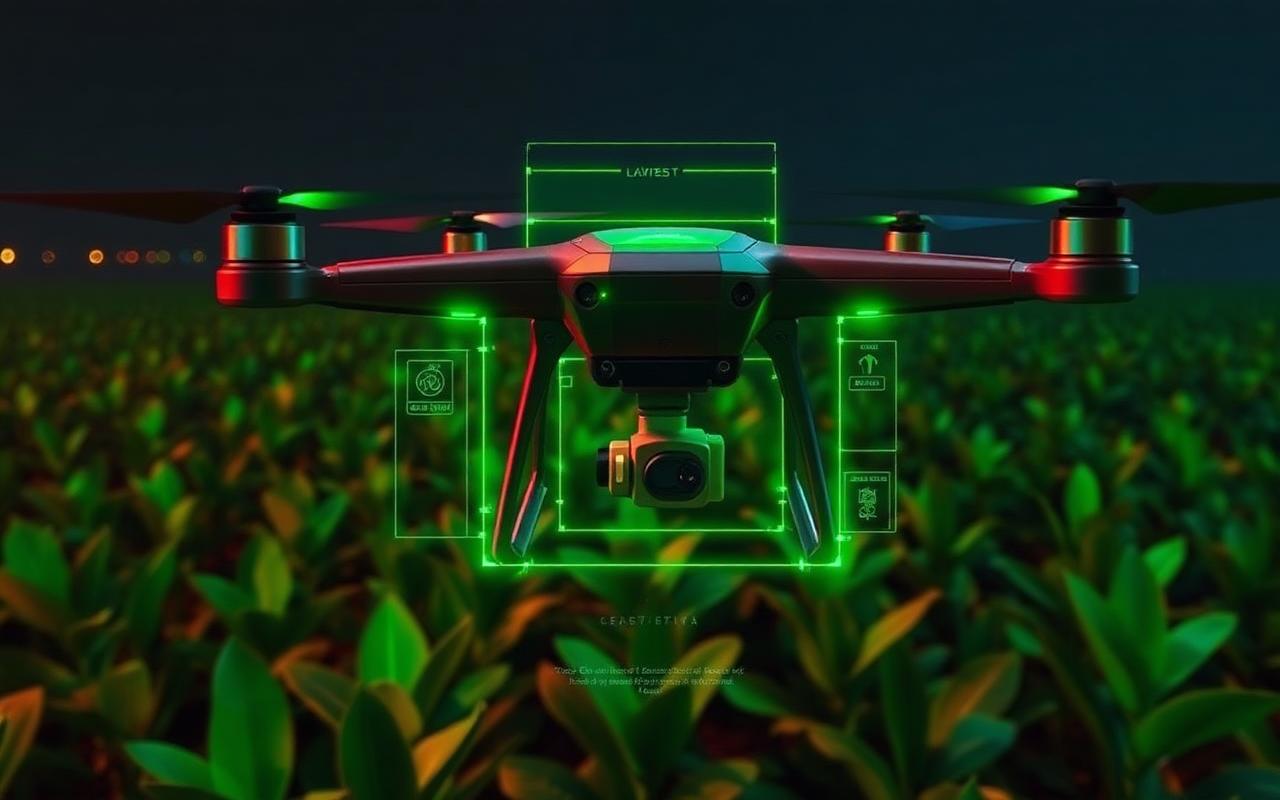
Cloud-based crop tools fail exactly where they're needed most. Nexcrop AI carries its full inference stack on-board, so detection latency is measured in milliseconds — not in the drive back to the farmhouse.
Real-time
On-device YOLO inference
Offline
Zero internet in the field
Adaptive
Severity-based spray rates
Traceable
GPS-tagged event logs
From dataset to field-validated system in six disciplined phases.
Months 0–2
Field data gathering, annotation and system design.
Months 2–4
YOLO training, severity estimation and validation.
Months 4–6
Jetson Nano deployment with TensorRT optimization.
Months 6–8
Spray logic and crop-specific control modules.
Months 8–10
Full pipeline: detect, decide, act — end to end.
Months 10–12
Real-world trials, evaluation and final reporting.
We'll walk your team through the model, the hardware and the field data.